English
  日本語
日本語  français
  Deutsch
  Español
  русский
  português
  العربية
  tiếng việt
  বাঙালি
  हिंदी
हिंदी 


A power track socket suits spaces where appliance positions change or more outlets may be needed later. A traditional wall socket remains simpler for fixed appliances and stable electrical layouts.
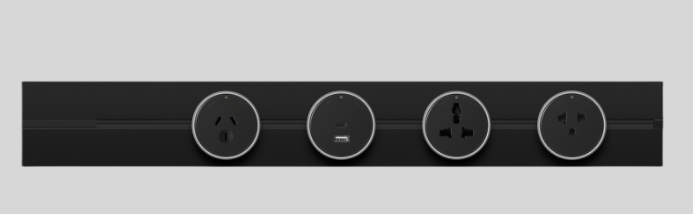
A power track socket is a modular electrical distribution system in which compatible socket or USB adapters connect to an energized rail and can be added, removed or repositioned along that rail.
Neither system is automatically safer. Safety depends on ratings, compatible components, earthing, circuit protection and local electrical rules.
What Is a Power Track Socket?
A power track combines a fixed rail with removable adapters, creating an integrated line of connection points rather than a loose cable.
A complete power track outlet can support regional socket and USB adapter options. FUTINA publishes ratings of 110–250 V, 32 A, 8,000 W and IP20 for its current range. These figures describe the system; they do not mean every adapter can be loaded to its maximum at the same time. The upstream circuit and lowest-rated component still set the practical limit.
IEC 60884-1:2022 covers household and similar plugs and socket-outlets up to 440 V and 32 A, while accessories using screwless terminals are limited to 16 A. Buyers should therefore check rail, adapter and terminal ratings separately.
Power Track Socket vs Traditional Wall Socket
The main difference is flexibility. Moving or adding wall sockets may require new wiring and wall repairs, while track adapters can be repositioned without moving the rail.
| Comparison point | Power track socket | Traditional wall socket |
| Outlet position | Repositionable along the rail | Fixed at the wall box |
| Expansion | Compatible adapters can be added | Extra outlets require wiring work |
| Initial cost | Usually higher | Usually lower for a few outlets |
| Appearance | Continuous, integrated rail | Separate faceplates |
| Load planning | Rail, adapter and circuit limits apply | Outlet and circuit limits apply |
| Best use | Kitchens, desks and changing layouts | Fixed appliances and stable layouts |
| Installation | Surface-mounted or recessed | Flush or surface wall box |
A movable power track socket is useful where coffee machines, monitors or chargers are frequently rearranged. FUTINA’s 2.0 range includes adapters rated at 10 A, 13 A or 16 A depending on regional socket type.
Choose a power track when:
·Appliance locations are expected to change.
·Several connection points are needed along one counter.
·Loose extension cords would create clutter or trip hazards.
·Different regional socket or USB modules are required.
·Future expansion is likely.
Power Track Socket vs Extension Cord
An extension cord provides temporary reach from an existing outlet. A power track creates an organized set of connection points as part of a planned installation.
The U.S. Consumer Product Safety Commission advises users not to overload extension cords, to check their ratings and to stop using a cord if any part becomes hot. The Electrical Safety Foundation International also states that extension cords are temporary solutions and should not be routed under rugs, through doors or across traffic areas.
A track removes the loose cable, but not the need for load management. Several high-power appliances connected together can still exceed the rail, branch circuit or protective-device rating.
This distinction matters in kitchens and offices. A temporary extension cord may be acceptable for occasional equipment, but it is not a substitute for properly planned permanent wiring. A power track offers a cleaner arrangement, yet it must still be connected to a suitable circuit and installed according to the manufacturer’s instructions.
Are Power Track Sockets Safe?
A power track must be assessed as a complete system: rail, conductors, insulation, earthing, adapter contacts and protective devices.
Before approving an installation, check:
·Rated voltage, current and power of rail and adapters.
·Protective earthing continuity.
·Required overcurrent and residual-current protection.
·Ingress-protection rating for the location.
·Compatibility between adapters and rail generation.
·Certifications accepted in the destination market.
FUTINA lists IP20 for its current track ranges. IP20 does not indicate water protection, so kitchen installations should stay outside splash zones and places where liquid can enter the rail.
The track’s maximum wattage should never be interpreted in isolation. The actual permitted load may be lower because of the branch circuit, plug adapter, local voltage or protective device. For example, a regional adapter rated at 10 A must not be treated as a 16 A adapter merely because both fit into the same rail.
A power track also does not increase the capacity of an existing circuit. Permanent wiring should be completed by a qualified installer.
Best Applications for a Power Track System
Power tracks work best where layouts change, including kitchen counters, offices and meeting rooms.
In a kitchen, users may reposition a kettle, coffee maker, blender or food processor without being restricted by a single wall outlet. In an office, adapters can follow monitors, laptops and charging equipment as desks are rearranged. Hotels, showrooms and training rooms may also benefit from a modular outlet layout.
A recessed power track suits new construction or major renovation where the rail can be integrated into cabinetry or wall finishes. FUTINA states that its 1.0 system can accommodate about 3 to 11 adapters depending on rail length, although total load limits still apply.
Surface-mounted tracks are generally easier to add during renovation because less cutting and finishing are required. Recessed tracks provide a more integrated appearance but require more accurate planning of the rail position, cable entry and surrounding materials.
Traditional electrical outlets and switches remain better for refrigerators, built-in ovens, washing machines and other equipment that stays in one position.
When Is a Traditional Wall Socket Better?
A wall socket is more practical when the load location is known during design. It uses established wiring methods and avoids paying for flexibility that will not be used.
Traditional sockets also suit dedicated appliance circuits, projects needing only one or two outlets, and wet or outdoor areas requiring purpose-designed protection. They may be easier to source and replace through local maintenance channels.
A fixed wall socket is often preferable where:
·One appliance will remain permanently in the same position.
·The appliance requires a dedicated circuit.
·Only one or two connection points are needed.
·Local electrical rules do not recognize the proposed track system.
·The installation is exposed to water, dust or outdoor conditions.
The choice should therefore be based on how the space will be used. A track system offers little benefit behind a built-in refrigerator, while a row of fixed sockets may be unnecessarily restrictive above a flexible kitchen worktop.
Power Track Procurement Checklist
For distributors, contractors and project buyers, selection should cover more than rail length and color.
Confirm:
·Destination-market plug standard and certifications.
·Rail length, finish and mounting method.
·Adapter types and current ratings.
·Maximum total load and upstream protection.
·Installation drawings, test reports and samples.
·OEM branding, packaging, spare parts and lead time.
Buyers should also confirm whether the rail and adapters belong to the same product generation. A newer adapter should not be assumed to fit an older rail unless the manufacturer has documented compatibility.
Do not mix adapters and rails from unrelated systems unless compatibility is documented. Similar dimensions do not prove safe contact or correct earthing.
Conclusion
Choose a power track for adaptable counters, desks and shared spaces where outlet positions may change. Choose traditional wall sockets for fixed appliances, dedicated circuits and simple layouts. In either case, compare ratings, installation environment, certification and branch-circuit capacity. Flexibility is valuable only when the system remains correctly protected and professionally installed.
Frequently Asked Questions
Is a power track socket safer than a wall socket?
Not automatically. Both can be safe when correctly certified, installed and used within their ratings. Power tracks require attention to rail-and-adapter compatibility, while wall sockets can still become unsafe through overloading, damage or poor wiring.
Can a power track handle high-power kitchen appliances?
Only when appliance, adapter, rail and circuit ratings all permit it. Do not rely on headline wattage alone or run several high-power appliances together if their combined load may exceed any component.
Can adapters be moved while an appliance is operating?
Follow the manufacturer’s instructions. A cautious approach is to switch off and unplug the appliance before moving an adapter, reducing the chance of arcing or contact damage.
Is a surface-mounted or recessed track better?
Surface mounting is easier for retrofits. Recessed installation offers a more integrated finish but is better planned during construction. Electrical performance depends on the product, not mounting style alone.
Does adding more adapters increase available power?
No. More adapters create more connection points, not more circuit capacity. The combined operating load must remain within the lowest applicable rating of the adapter, rail, wiring or protective device.
Can a power track permanently replace an extension cord?
A properly installed power track can provide a permanent, organized alternative where movable outlets are needed. Extension cords should remain temporary and must be used within their marked capacity.
Table of Content
[Hide]