English
  日本語
日本語  français
  Deutsch
  Español
  русский
  português
  العربية
  tiếng việt
  বাঙালি
  हिंदी
हिंदी 


A kitchen exhaust fan should be selected by required airflow, not diameter alone. For a whole-room fan that is not above the cooking surface and has no capture hood, ASHRAE recommends 15 air changes per hour, or ACH, as a design reference. An 18 m³ kitchen therefore needs about 270 m³/h, while a 54 m³ kitchen needs about 810 m³/h before installation losses.
A kitchen exhaust fan is a mechanical ventilation device that removes warm, humid, odor-laden and contaminated air from a kitchen and discharges it outdoors.
This guide covers wall, window and ceiling fans used for general room ventilation. It does not replace a properly designed range hood or a code-compliant commercial kitchen exhaust system.
What Size Exhaust Fan Does a Kitchen Need?
First, calculate the kitchen’s internal volume:
Kitchen volume = length × width × ceiling height
Then calculate the baseline airflow:
Required airflow in m³/h = kitchen volume in m³ × target ACH
For imperial measurements:
Required CFM = room volume in ft³ × ACH ÷ 60
The table below uses ASHRAE’s 15 ACH reference for whole-kitchen exhaust fans that are not installed above the cooking surface and do not have a capture hood. Local building codes, appliance types and site conditions still apply.
| Example kitchen dimensions | Room volume | Airflow at 15 ACH | Approximate CFM | Typical starting size* |
| 3.0 × 2.5 × 2.4 m | 18.0 m³ | 270 m³/h | 159 CFM | 6–8 inch |
| 4.0 × 3.0 × 2.4 m | 28.8 m³ | 432 m³/h | 254 CFM | 8–10 inch |
| 4.5 × 4.0 × 2.4 m | 43.2 m³ | 648 m³/h | 381 CFM | 10–12 inch |
| 5.0 × 4.0 × 2.7 m | 54.0 m³ | 810 m³/h | 477 CFM | 12 inch or engineered solution |
*Fan diameter is only an initial screening guide. The final decision should be based on tested airflow under the expected installation pressure.
Choose the next performance level when:
·Frying, wok cooking or high-moisture cooking is frequent.
·The fan uses a long duct or several bends.
·The kitchen opens into a larger living or dining area.
The calculation should be based on the entire connected space when doors remain open and air moves freely between the kitchen and adjacent rooms.
6-Inch vs 8-Inch vs 10-Inch vs 12-Inch Exhaust Fans
A larger opening can support a larger impeller, but diameter does not guarantee airflow. Blade shape, motor speed, grille resistance, shutter design and duct pressure all affect actual performance.
A 6-inch fan generally suits compact kitchens with a short, direct outlet. An 8-inch model provides more capacity for small-to-medium rooms. A 10-inch fan is more suitable where room volume or duct resistance is higher. A 12-inch fan is often considered for large residential kitchens and light commercial rooms, although grease-producing cooking may still require a capture hood.
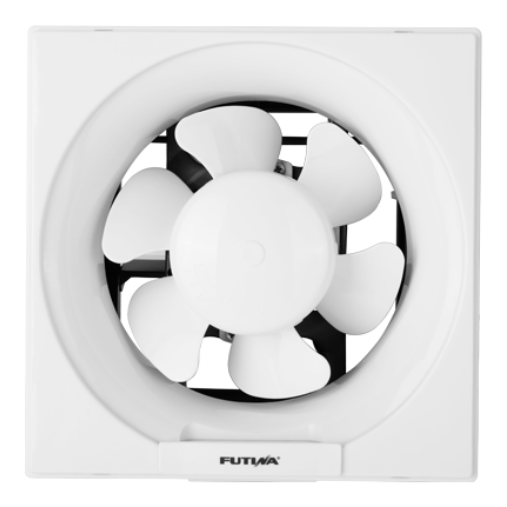
FUTINA’s wall-mounted range includes 6-, 8-, 10- and 12-inch models, with published airflow across the series of 290–980 m³/h. This broad range shows why buyers should compare individual model data rather than assume every fan with the same diameter performs alike.
A wall mounted kitchen exhaust fan is practical where the fan can discharge through a short exterior-wall opening. A shorter airflow path generally reduces pressure loss and makes maintenance easier.
Where wall cutting is restricted, an exhaust fan for kitchen window may simplify a retrofit. It still needs secure mounting, weather protection and an unobstructed outdoor discharge path. FUTINA’s window-mounted range includes compact models intended for wall, glass and window installations.
Wall, Window or Ceiling Installation?
The best mounting position creates a short route outdoors and draws polluted air away from occupied areas. The U.S. Environmental Protection Agency recommends exhausting cooking-related indoor air outdoors and identifies kitchen and window exhaust fans as useful ventilation measures.
A wall fan is usually the simplest option when an exterior wall is available. A window fan can avoid masonry work, but the window frame and glazing must support the appliance.
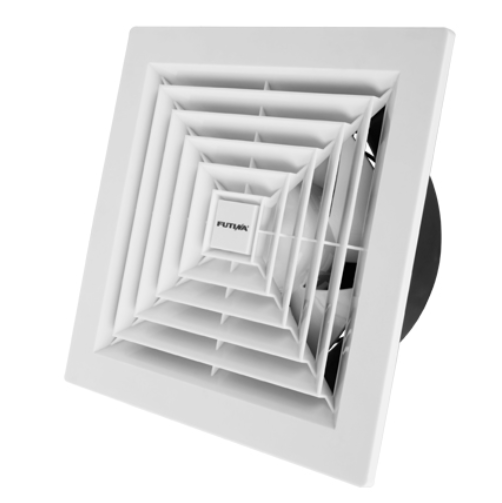
A ceiling mounted exhaust fan works where there is a suitable ceiling void and correctly sized ductwork. However, a long ceiling duct can reduce the airflow delivered into the room. FUTINA’s ceiling-mounted range covers 8-, 10- and 12-inch models, with published airflow of 150–210 m³/h across the listed series.
Source capture remains preferable whenever possible. The EPA advises using an outdoor-vented range hood whenever cooking and leaving it operating for 10–20 minutes after cooking. A general room fan can remove heat, moisture and lingering odors, but it does not capture the cooking plume as effectively as a hood positioned above the appliance.
Factors That Reduce Actual Exhaust Fan Airflow
Catalog airflow is measured under defined test conditions. Once a fan is installed, resistance can reduce the volume of air it delivers. The Home Ventilating Institute recommends matching the duct size to the fan connection, keeping ductwork short and limiting changes in direction.
Common causes of airflow loss include:
·Undersized ducts that restrict the air passage.
·Several elbows, especially tight 90-degree bends.
·Dirty grease screens, shutters or fan blades.
·Backdraft dampers that do not open freely.
·Insufficient replacement air in a tightly sealed room.
For example, a fan rated at 400 m³/h in open-air testing may deliver less after it is connected to a narrow duct with several bends. Buyers should therefore review airflow curves or static-pressure data when these figures are available.
Do not compensate automatically by selecting the largest fan. Oversizing may create unnecessary noise, uncomfortable drafts or negative pressure. In homes with fuel-burning appliances, powerful extraction can also contribute to backdrafting, so local requirements and professional advice matter.
Residential vs Heavy-Duty Kitchen Exhaust Fans
Residential exhaust fans usually handle intermittent moisture, heat and odors. Commercial kitchens produce more grease, smoke and heat over longer operating periods, and ASHRAE treats their ventilation requirements differently from those of residential kitchens.
A heavy duty exhaust fan for kitchen use may suit a hotel back area, food-preparation room or light commercial workspace requiring whole-room air exchange. FUTINA’s industrial series includes 6-, 8-, 10- and 12-inch models with a published airflow range of 180–800 m³/h.
However, a general axial exhaust fan should not be treated as a substitute for a listed grease hood where local codes require one. Commercial buyers should confirm the cooking equipment classification, grease load, required capture area, fire-suppression provisions and replacement-air requirements before selecting equipment.
For product procurement, confirm:
·Rated airflow and the test condition used.
·Voltage, frequency, input power and motor protection.
·Opening dimensions, mounting depth and installation method.
·Materials suitable for humid or grease-prone environments.
·Certifications required in the destination market.
·OEM labeling, packaging, spare parts and production lead time.
Conclusion
Calculate kitchen volume first, use 15 ACH as a reference for a non-capture whole-room fan, and allow for duct losses. A 6-inch fan may suit a compact kitchen, while larger rooms often need 8-, 10- or 12-inch models. Final selection should be based on verified airflow, installation conditions, cooking intensity and local ventilation rules—not diameter alone.
Frequently Asked Questions
Is a 6-inch exhaust fan enough for a kitchen?
A 6-inch fan may be enough for a compact kitchen with a short and direct outdoor discharge path. Compare the fan’s rated m³/h or CFM with the calculated room requirement. Frequent frying, open-plan layouts and restrictive ductwork usually require greater capacity.
How many CFM does a kitchen exhaust fan need?
For a whole-room fan without a capture hood, multiply the kitchen volume in cubic feet by 15 ACH and divide the result by 60. A 1,000 ft³ kitchen therefore has a baseline requirement of approximately 250 CFM before duct and installation losses are considered.
Is a 12-inch exhaust fan always better?
No. A 12-inch diameter does not automatically mean better ventilation. Buyers should check tested airflow, sound level, power consumption, shutter resistance and performance under static pressure. A smaller, well-designed fan may outperform a poorly designed larger model.
Should a kitchen exhaust fan vent outdoors?
Yes. Outdoor discharge removes heat, moisture and cooking pollutants from the building. A recirculating filter may reduce some grease particles or odors, but it does not remove contaminated air as effectively as a properly installed outdoor exhaust system.
Can a wall exhaust fan replace a range hood?
Not usually. A wall exhaust fan ventilates the room, while a range hood captures contaminants closer to the cooktop. Kitchens with gas appliances, frequent frying or commercial cooking generally benefit from source capture and may be subject to specific ventilation codes.
How long should the exhaust fan run after cooking?
The U.S. EPA recommends leaving an outdoor-vented range hood operating for 10–20 minutes after cooking. A general kitchen exhaust fan may also continue running until visible steam, excess humidity and strong cooking odors have cleared.
Table of Content
[Hide]